
Fascism and Faërie
Fantastic Antitheses

[Note: This essay is an expanded version of a paper I gave on June 25, 2026 at the inaugural European Conference on the Fantastic in Glasgow. This is a work-in-progress, one piece of much larger project on Tolkien, nationalism, and the history of religion. Feedback welcome!]
…
Introduction: A Fascist Fairy-story?
In many respects, U.S. Vice President J.D. Vance and I are funhouse mirrors of one another, and not only because we are both bearded, overeducated White American Millennial men who hail from economically depressed mountain regions of the United States. We are both adult converts to Christianity. But whereas Vance is a onetime Protestant turned Catholic arch-reactionary who may have accidentally killed the late Pope Francis through his sheer lack of charisma (Olmsted 2025), I am a onetime Catholic turned multireligious Protestant theologian who looks to Pope Leo XIV’s recent encyclical Magnifica Humanitas (2026) and Catholic Social Teaching for inspiration. Similarly, we both call The Lord of the Rings our favorite novel (Wren 2024). But whereas Vance named his tech venture capital firm Narya Capital, one of the three Elven-Rings of Power, I wrote a PhD about The Lord of the Rings and nonreligion at the University of Glasgow (Emanuel 2026). Make of that what you will.
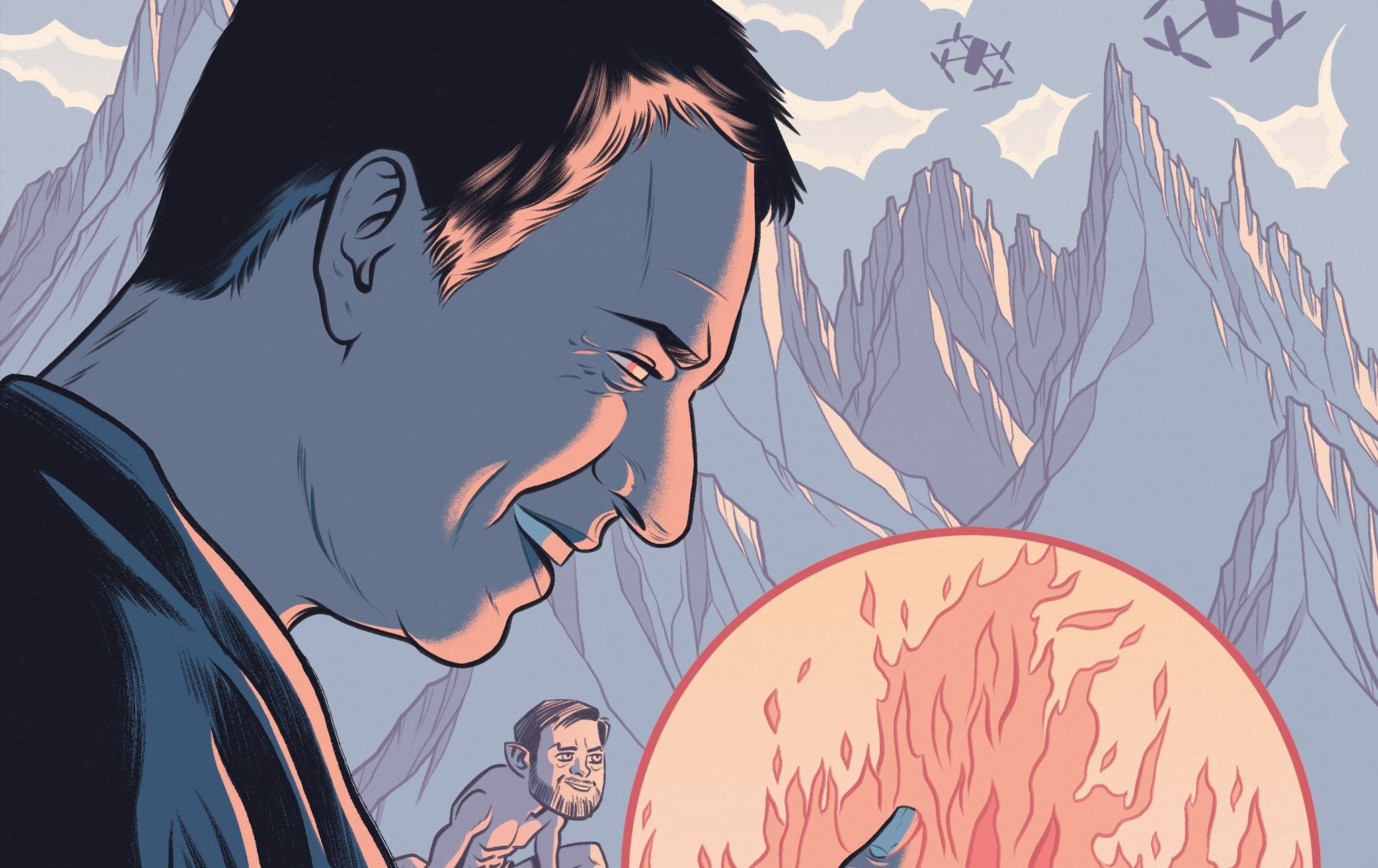
That Tolkien has a vocal, increasingly powerful rightwing fanbase will come as no surprise to readers of this newsletter (cf. Bülles 2026). Vance is one such prominent voice; others include techno-authoritarian Palantir founder Peter Thiel, white supremacist trillionaire Elon Musk, self-styled neo-monarchist “intellectual” Curtis Yarvin; and far-right Italian Prime Minister Giorgia Meloni. Tolkien would likely have found his far-right “cultus” every bit as “deplorable” as the American college students to whom he applied that label in the late 1960s (Carpenter 2000, 233). But the example of Giorgia Meloni points to a history of Tolkienian appropriation on the Italian New Right stretching back to the late 1960s. The ultranationalist Movimento Sociale Italiano, from which Meloni’s party Fratelli d’Italia (Brothers of Italy) is descended, infamously hosted a neo-fascist “Camp Hobbit” in 1977 (Franson, forthcoming; Griffin 1985, 103). Ever since The Lord of the Rings’s first bloom of popularity, the far right has detected ideological resonances in Middle-earth (Tally 2024).
As celebrated theorist of race and fantasy Helen Young pointed out in a June 2026 keynote lecture, such resonances do not echo out of nowhere. Endemic themes of historical decline; nostalgia for an enchanted past; mythopoeic appropriation of Northern European legends; and racialized hierarchies all present reactionary affordances. That being readily admitted, I nevertheless argue that, although they share undeniable intellectual and cultural roots in common, Tolkien’s legendarium nevertheless stands in opposition to fascistic projects of racial, cultural, and political domination. We can understand both Tolkien’s legendarium and fascism as enchanted worlds, constructed in response to a felt sense of disenchantment under Western modernity. But the legendarium’s reflexive fictionality; its insistence on the inevitability of death and necessity of change; and its critique of the power to dominate others as a violation of their God-given freedom and dignity, all sharply contrast with dreams of imposing an ideological fantasy onto the Primary World at gunpoint.
Wretched Orcs and Revolting Fascists
It is worth pointing out that Tolkien personally denounced the leaders and policies of Nazi Germany. He responded to a German publisher’s inquiries into his “Aryan” origins with righteous indignation (Letters 47-48, #29-30) and wrote of his “burning private grudge […] against that ruddy little ignoramus Adolf Hiter” for “[r]uining, perverting, misapplying, and making for ever accursed, that noble northern spirit, a supreme contribution to Europe, which I have ever loved, and tried to present in its true light” (Letters 77, #45). (Sidebar: could there be a more Tolkienian insult for Hitler than “ruddy little ignoramus?”) At the same time, like many English Catholics of the 1930s, Tolkien supported Francisco Franco’s Nationalist forces in the Spanish Civil War, viewing them as a bulwark against the anti-Catholicism of the Republican faction (Ferrández Bru 2011, 17). He later abjured his Francoist sympathies, to his credit (Carpenter 1979, 192). But these biographical facts do not protect his legendarium from a certain openness to reactionary appropriations (Franson, forthcoming; Tally 2024).
Such appropriations find their strongest, most pernicious purchase in Middle-earth’s racial hierarchies. In a posthumously published essay entitled “The Wretched of Middle-earth: An Orkish Manifesto,” Caribbean-American political philosopher Charles Mills writes:
What Tolkien has in effect done, then, is to project onto a fantasy earth the central racist myth of the last millennium: that all human culture comes from the whitest of white peoples, speaking the whitest of languages, and that non-whites are a threat to civilization, culture, and humanity. […] One could say, only half in jest, that The Lord of the Rings is a medievalist’s revenge on the unacknowledged and undesired ancestors of medieval Europe’s civilization. The literal genocide of the orcs with which the book concludes is in a sense of secondary importance to the cultural genocide that their creation signified in the first place. […] Could there be a clearer indictment of the West’s willed ignorance of its own past, of the continued naturalness to its vision of racially-structured categorizations of personhood, than the fact that this book should have been hailed for nearly four decades for its moral insight and metaphysical truth? It is a blindness that precludes any genuine re-seeing of the orcs of the past—and present. (2022, 135)
For the responsible reader, such searing critique should be cause for self-reflection if nothing else (cf. Thomas 2019, 23-29). Even Tolkien recognized the problem posed by his Orcs, agonizing late in life over the moral status of an apparently irredeemable race of humanlike beings (Morgoth 409-311). Unfortunately, the “racist, heteronormative worldview that his right-wing readers have made a ‘privileged reading’ of his works” (Franson, forthcoming) is an active draw to white supremacist and ultranationalist Tolkien fans such as the Italian neo-fascists I mentioned earlier.
Inspired by the esoteric Traditionalist ideology of Julius Evola, the Italian New Right of the 1960s and 1970s embraced Tolkien for his supposed “revolt against the modern world.” As Evola would have it, “All the social institutions and spiritual forces that constitute the ‘modern’ age are symptoms of an irreversible decline from the world of Tradition” (Griffin 1985, 104). For his followers and fellow-travelers, “the exploration of myths and legends from the past […] [was] associated with the attempt to by-pass the reductionist intellectualism which is associated with secular, ‘technocratic’ reason and get in touch with a saner, more integrated, ‘primordial’ vision of reality” (110). Evola’s acolytes believed—and their ideological inheritors still believe—that The Lord of the Rings offers a glimpse of just such a vision.
The eminent scholar of fascism Roger Griffin writes that “[c]entral to the cult of figures such as Tolkien and Evola” on the far right is “nostalgia for a total world view, a holistic understanding of existence, warm and ‘alive’, immune to the icy winds of scepticism and relativism that waft from the official institutions of culture and learning” (113). Indeed, he theorizes fascism writ large precisely as “the bid to reinstate a sense of transcendent value, meaning, or purpose in order to reverse the Western culture’s progressive loss of a homogeneous value system and overarching cosmology (nomos) caused by the secularizing and disembedding forces of modernization” (15, emphasis in original).
To borrow a phrase made famous by Max Weber, it is an attempt to re-enchant a disenchanted world. And since enchantment is also precisely the word that Tolkien uses to describe that “elvish craft” by which a storyteller calls the Secondary World of fantasy into being (OFS 63), it is worth exploring exactly what is meant by enchantment; what it means to say that modernity is disenchanted; and the forms a project of mythopoeic re-enchantment might take.

Myth, Folklore, Nationalism: Re-enchanting a Disenchanted World
In his seminal book A Secular Age (2007), the philosopher Charles Taylor lays out a history of the disenchantment of the world in modernity. According to Taylor, the nonmodern enchanted world is charged with spirits and nonhuman intelligences (2007, 25-26): “all that exists, lives” (Sahlins 2022, 77; cf. Kimmerer 2013, 198-201; Rosegrant 2022, 9; Saler 2012, 8). The self who navigates this inspirited world is porous, vulnerable to influence by nonhuman Others for good and for ill (Taylor 2007, 38). This porous self is defined in the context of a communal and cosmic order of which it is one small, interlocking part, incarnate and embedded in geography, ecology, and society (147-153; cf. Veldman 1994, 17). In light of this holism, meaning is not solely self-generated; it is also “out there” for us to encounter in the world, often in the form of an overarching narrative or narratives that lend purpose and direction to human life (Taylor 2007, 33-34).
By the mid-nineteenth century, the complexly interacting forces of post-Enlightenment rationalism, modern scientific knowledge-to-power, and white supremacist capitalist Empire increasingly gave rise to the disenchantment of the world (2004, 12-13). The disenchanted modern self is buffered: the bounded, rational individual, disembedded from the web of relationships in and by which it had previously been constituted (Taylor 2007, 38, 149-150; cf. Sahlins 2022, 124-125). The buffered self is also excarnated, cut off from emotion, the body, connection with more-than-human nature, and other nonrational elements of experience (Taylor 2007, 288; cf. Mandair and Dressler, 11-12; McGuire 2008, 40-41). Time and space become homogenous and unilinear, resources to be deployed and exploited (Taylor 2007, 58), and the dominant meaning-making structures—which in the premodern West meant, first and foremost, Christianity—lose their hegemonic grip on the human imagination. An alternative mode of human being-in-the-world arises. These paradigm shifts culminate in what Taylor calls the immanent frame (542).
Neither Taylor no I have any desire to reify premodern Western Christendom and its socio-cosmic hierarchies. Modernity and its offshoots have unlocked radically new possibilities for human being and becoming: women’s rights, the abolition of serfdom, widespread literacy, modern medicine, movements for social and political liberation, space for radically new forms of self-expression and self-making (Taylor 2007, 578-579). Even if one felt nothing but “bereavement and despair at what was lost” (Taylor 2024, 71), however, there is no returning to “the era of ‘naïve’ religious faith” (Taylor 2007, 19). Disenchanted modernity does not just offer an alternative to religious belief; it alters the conditions under which one believes in the first place. It represents the first time, to my knowledge, that a disenchanted world has radically challenged and in many places bulldozed the enchanted one. It is not merely that a Christian world can no longer be taken for granted. An enchanted world can no longer be taken for granted, Christian or otherwise.
Yet premodern Western Christianity and modern Western secularity are far from the only options on offer. The immanent frame may be an alternative, but for many Westerners such as myself, it remains a deeply unsatisfying one. Content with neither enchanted premodernity nor disenchanted modernity, we are both post-Christian and postsecular at one and the same time (Branch 2016, 97-99; Ni 2022, 241-250; Taylor 2007, 534-535). There thus arises a felt need for re-enchantment. This cannot mean a return to uncomplicated belief in old cosmic orders. Reversion to the status quo ante is neither possible nor desirable. To restore a sense of meaning and connectedness to lived experience, then, post-Christian technologies of re-enchantment need to draw upon a variety of other cultural, aesthetic, and affective resources – including those made available by the advent of disenchantment itself. I want to focus on two modalities of post-Christian re-enchantment which I believe are especially relevant for discussing fascism and Faërie, their similarities and their differences: myth and folklore studies and Romantic nationalism.
Tolkien came at the end of what Dimitra Fimi calls a “golden century” of British folklorists (2008, 55). Folktales were seen as the “ruins” of a previous age, belonging to the primitive childhood of human cultural evolution. For some folklorists, this meant that humanity had moved beyond a world in which such relics were useful; we were now called to “put an end to childish ways” (1 Cor. 13:11, NRSVUE) and enter upon a new era of industrial progress and scientific-rational enlightenment (Hutton 1999, 113-114). For others, the facticity or even plausibility of folktales was neither here nor there. They embodied the distinctive culture and language of the peoples to whom they belonged, and could thus be used as the raw material for creating “a common national mythology expressing the soul of the ‘Volk’ (Fimi 2008, 51; cf. Hutton 2022, 166).” Especially significant in this respect was Elias Lönrott’s Finnish Kalevala, which inspired Tolkien’s onetime project of reconstructing a “mythology for England” out of the fragments of Old English legends (Carpenter 2000, 66; Fimi 2008, 53-54).
This surge in interest in folklore and mythology was both motivated by and fed into Romantic nationalist movements of the nineteenth and early twentieth centuries. These movements can be understood as a response to the loosening of the bonds—linguistic, cultural, and political—of the imagined community of Western Christendom. In his classic Imagined Communities: Reflections on the Origin and Spread of Nationalism (1983/2006), Benedict Anderson writes that in the wake of disenchantment, “the search was on, so to speak, for a new way of linking fraternity, power and time meaningfully together” (2006, 36). A shared linguistic heritage, and therefore a shared narrative heritage, was critical to the social imaginary of the modern nation (70, 154). I have just mentioned Tolkien’s onetime dream of forging a “mythology for England.” Recent research into letters between Tolkien and the T.C.B.S., his tightknit cadre of likeminded schoolmates, reveals the overt nature of their intention to use their art to cleanse and renew the soul of England (Sherwood, forthcoming).
Tolkien was forced to abandon his nationalist ambitions, however (Shelton 2022). There was too little raw material to work with in the way of pre-Christian English folklore, as distinct from, say, Celtic or Norse (Fimi 2008, 55). More to the point, his Secondary World quickly took on an imaginative life of its own that overran any primary-world referents (Letters 203-204, #131), such as the early identification of Kortirion, the Elvish capital of Tol Eressëa, with Warwick (Lost Tales I 24-25). That the discourses of fin-de-siècle European nationalism course throughout his work is hardly to be contested (Saler 2012, 172-178).
Fascism and Faërie: Fantastic Antitheses
Despite their common foundations in this turn-of-the-century milieu of re-enchantment, Tolkien’s mythopoeic project, and the ones upon which his fascist and neofascist interpreters are embarked, are fundamentally incompatible. First, the enchanted world which Tolkien evokes is explicitly fictional. Despite the impossibility of reconstructing a coherent mythology for England, or even one “which I could dedicate simply to: to England; to my country” (Letters 203, #131), Tolkien’s desire to connect the enchanted past of the text to the disenchanted present of the reader in a line of direct transmission remained a lifelong obsession, resulting in a metafictional apparatus that grew ever more intricate over the course of his lifetime (Flieger 2005, 61). But no matter how clever the conceit may be that The Lord of the Rings is actually an ancient text, composed and redacted by Frodo and Sam and their heirs, which Tolkien merely discovered and translated for modern readers, it remains a metafiction. The gap between fantasy and history could never be closed. Tolkien’s simultaneous longing for the reality of his own Secondary World, and his regretful acceptance of its literary unreality, may be one source of that “impression of depth” (M&C 27) which so impresses his readers. The enchanted world of fascism has a certain impression of depth as well, in part as a result of its engagement with some of the same historical materials and discourses as Tolkien’s. But it is a sociopolitical fantasy, just as surely as Middle-earth is a literary one. Its acolytes are not self-aware of this fact as Tolkien was, however, and dattempt to impose their fantasy on the Primary World by force instead of accommodating themselves to its constitutional unreality.
Second, and relatedly, Tolkien’s is undoubtedly a fading world. This would prima facie resonate with far-right belief in Western “decadence” leading to national decline, cultural weakness, and racial impurity (Eco 1995; Mitchell 2011, 10, 14; Robin 2018, 71-73). But in Middle-earth, fading is sorrowful because it is inescapable: “the long defeat,” as Galadriel calls it (LotR II.7, 357). Even the triumph over Sauron and prophesied Return of the King in The Lord of the Rings are only temporary. In the very same instant in which Sauron is defeated, the power of the Elven-Rings to preserve ancient enchantment is undone. The eucatastrophic salvation of Middle-earth is at one and the same time a dyscatastrophe of world-shaking proportions. And in Tolkien’s metafiction, Middle-earth is a “mythical ‘proto-prehistory’” of our own world (Fimi 2008, 125). This means the world of modern readers is “descended” from the world of LotR, which is descended from the world of The Silmarillion, in a long process of progressive disenchantment. As Tolkien reiterated on multiple occasions, the great theme of his legendarium is death: the necessity of letting go of the past even as we yearn for it (Letters 385-386, #208; cf. Pezzini 2025, 99-101, 107-108). Fascism, by contrast, insists that the Volk, embodied by the Party and especially the transcendent person of the Leader, can arrest history’s decline by sheer force of will and bring about a future golden age (Caplan 2019, 15-17; Griffin 2008, 16-18).
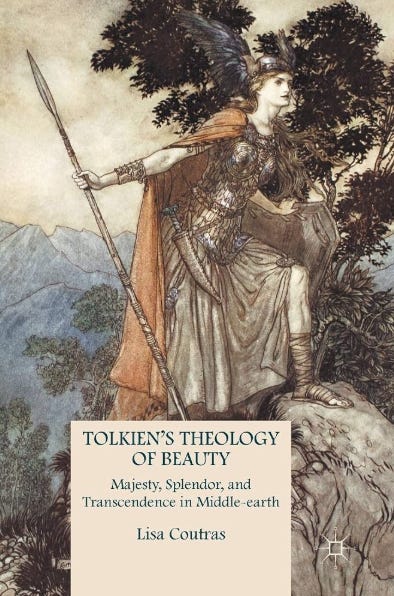
This points toward the third and greatest disjuncture between Tolkien’s literary mythology and the political mythologies of fascism: their respective ideologies of power. Key to Tolkien’s understanding of fantasy is the notion of Recovery which Tolkien introduces in his seminal essay “On Fairy-stories” (OFS 67). By inviting us into an enchanted Secondary World, fantasy can help us to see things in the Primary World “as we are (or were) meant to see them (67). Fantasy can help us regain “a clear view” of the world as, well, enchanted: full of living, wondrous Others who exist entirely apart from us:
Creative fantasy, because it is mainly trying to do something else (make something new), may open your hoard and let all the locked things fly away like cage-birds. The gems all turn into flowers or flames, and you will be warned that all you had (or knew) was dangerous and potent, not really effectively chained, free and wild; no more yours than they were you. (68)
Elsewhere, Tolkien calls this the “love of Faery […] a relationship towards all things, animate and inanimate, which includes love and respect, and removes or modifies the spirit of possession and domination” (Smith 131). We are called to “love and respect” the Others with whom we share the world, both human and nonhuman, “animate and inanimate,” precisely on account of their Otherness. The domination of other will is the cardinal sin in Tolkien’s legendarium, from the primeval fall of the Luciferian angel Melkor in The Silmarillion right on down to the all-corrupting One Ring in The Lord of the Rings. Fantasy is meant, in part, to convert us away from the twisted ethic of dominion. Nothing could be further from fascist projects of ideological supremacy, militaristic expansion, and genocidal violence; for the primary-world realization of far-right fantasies is contingent upon the eradication of difference and prostration before the bloody altar of racism, sexism, queerphobia, and imperialism (Caplan 2019, 14-17; Tillich 1957, 11-12).
I do not wish to brush off the justified critiques which Mills and others have leveled against Tolkien’s racialized hierarchies. I do not wish to deny the legendarium’s most troubling elements and tendencies, nor to claim that it consistently lives up to the “love of Faery” which its author championed (Smith 131). I will claim, however, that even when we acknowledge his limitations, Tolkien retains the power to re-enchant the world of the reader without falling into the ultranationalist trap of treating re-enchantment as a political program, “bulldozing the real world [and] coercing other wills” (Letters 205, #131). In both form and content, Middle-earth subverts its own reactionary potentialities and subverts attempts at misappropriation and exploitation. I go further: it provides a powerful mythic and ethical framework for critiquing—and resisting—the very same authoritarians who would claim it as their own.
Bibliography
Anderson, Benedict. 2006. Imagined Communities: Reflections on the Origin and Spread of Nationalism. Rev. ed. Verso.
Branch, Lori. 2016. “Postsecular Studies.” In The Routledge Companion to Literature and Religion, edited by Mark Knight. Routledge.
Bülles, Marcel R. 2026. “A (Hopefully Exhaustive) List of the Neo-Fascist Tech Bros Companies and Projects Abusing Tolkienian Names.” The Tolkienist, June 28. URL.
Caplan, Jane. 2019. Nazi Germany: A Very Short Introduction. Oxford University Press.
Carpenter, Humphrey. 1979. The Inklings: C.S. Lewis, J.R.R. Tolkien, Charles Williams, and Their Friends. Houghton Mifflin.
Carpenter, Humphrey. 2000. J.R.R. Tolkien: A Biography. Houghton Mifflin.
Eco, Umberto. 1995. “Ur-Fascism.” The New York Review of Books, June 22. URL.
Emanuel, Tom. 2026. “The Tale We’ve Fallen Into: J.R.R. Tolkien’s The Lord of the Rings and the Post-Christian Quest for Meaning.” PhD diss. University of Glasgow. URL.
Ferrández Bru, José Manuel. 2011. “J.R.R. Tolkien and the Spanish Civil War.” Mallorn 51: 16-19. URL.
Fimi, Dimitra. 2008. Tolkien, Race and Cultural History: From Fairies to Hobbits. Palgrave Macmillan.
Flieger, Verlyn. 2005. Interrupted Music: The Making of Tolkien’s Mythology. Kent State University Press.
Franson, Craig. Forthcoming. “Appropriations.” In The Oxford Handbook of J.R.R. Tolkien, edited by Luke Shelton and Dimitra Fimi. Oxford University Press.
Griffin, Roger. 1985. “Revolts Against the Modern World: The Blend of Literary and Historical Fantasy in the Italian New Right.” Literature and History 11 (1): 101-123. URL.
Griffin, Roger. 2008. “Modernity, Modernism, and Fascism: A ‘Mazeway Resynthesis’.” Modernism/modernity 15 (1): 9-24. URL.
Hutton, Ronald. 1999. The Triumph of the Moon: A History of Modern Pagan Witchcraft. Oxford University Press.
Hutton, Ronald. 2022. Queens of the Wild: Pagan Goddesses in Christian Europe. Yale University Press.
Kimmerer, Robin Wall. 2013. Braiding Sweetgrass: Indigenous Wisdom, Scientific Knowledge, and the Wisdom of Plants. Milkweed Editions.
Mandair, Arvind-Pal S. and Markus Dressler. 2011. “Introduction: Modernity, Religion-Making, and the Postsecular.” In Secularism and Religion-Making, edited by Markus Dressler and Arvind-Pal S. Mandair. Oxford University Press.
McGuire, Meredith B. Lived Religion: Faith and Practice in Everyday Life. Oxford: Oxford University Press, 2008.
Mills, Charles W. 2022. “The Wretched of Middle-Earth: An Orkish Manifesto.” The Southern Journal of Philosophy 60 (1): 105-135. URL.
Mitchell, Philip Irving. 2011. “‘Legend and History Have Met and Fused’: The Interlocution of Anthropology, Historiography, and Incarnation in J.R.R. Tolkien’s ‘On Fairy-stories.’” Tolkien Studies 8: 1-21. URL.
Ni, Zhange. 2022. “Fantasy: Magical Experiences and Postsecular Fiction.” In Literature and Religious Experience: Beyond Belief and Unbelief, edited by Matthew J. Smith and Caleb D. Spencer. Bloomsbury Academic.
Olmsted, Edith. 2025. “Did J.D. Vance Kill the Pope? An Investigation.” The New Republic, April 21. URL.
Pezzini, Giuseppe. 2025. “Tolkien and Newman: Towards a Theology of History.” In Tolkien among the Theologians, edited by Austin M. Freeman. Walking Tree Publishers, 2025.
Pope Leo XVI. 2026. Magnifica Humanitas. Encyclical Letter on Safeguarding the Human Person in the Time of Artificial Intelligence. The Holy See, May 15. https://www.vatican.va/content/leo-xiv/en/encyclicals/documents/20260515-magnifica-humanitas.html.
Robin, Corey. 2018. The Reactionary Mind: Conservatism from Edmund Burke to Donald Trump. 2nd ed. Oxford University Press.
Rosegrant, John. 2022. Tolkien, Enchantment, and Loss: Steps on the Developmental Journey. Kent State University Press.
Sahlins, Marshall. 2022. The New Science of the Enchanted Universe: An Anthropology of Most of Humanity. Edited by Frederick B. Henry, Jr. Princeton University Press.
Saler, Michael. 2012. As If: Modern Enchantment and the Literary Prehistory of Virtual Reality. Oxford University Press.
Shelton, Luke. 2022. “Why Calling Tolkien’s Work ‘A Mythology for England’ is Wrong and Misleading.” Luke Shelton PhD, February 12. URL.
Sherwood, Will. Forthcoming. “‘I sit beside the fire and think’: J.R.R. Tolkien, British Romanticism, and Their Cultural Legacies.” PhD diss. University of Glasgow.
Tally, Robert. 2024. “Tolkien’s Deplorable Cultus: Right-Wing Hobbit Enthusiasts and the Urgency of Marxist Criticism in Fantasy.” Spectre, August 20. URL.
Taylor, Charles. 2007. A Secular Age. Harvard University Press.
Taylor, Charles. 2024. Cosmic Connections: Poetry in the Age of Disenchantment. Harvard University Press.
Thomas, Ebony Elizabeth. 2019. The Dark Fantastic: Race and Imagination from Harry Potter to the Hunger Games. New York University Press.
Tillich, Paul. 1957. The Dynamics of Faith. Harper & Row.
Tolkien, J.R.R. 1983. The Book of Lost Tales, Part I. Edited by Christopher Tolkien. Houghton Mifflin.
Tolkien, J.R.R. 1983. The Monsters and the Critics and Other Essays. Edited by Christopher Tolkien. HarperCollins.
Tolkien, J.R.R. 1983. The Monsters and the Critics and Other Essays. Edited by Christopher Tolkien. HarperCollins.
Tolkien, J.R.R. 1994. Morgoth’s Ring. Edited by Christopher Tolkien. Houghton Mifflin.
Tolkien, J.R.R. 2004. The Lord of the Rings. 50th Anniversary ed. HarperCollins, 2004.
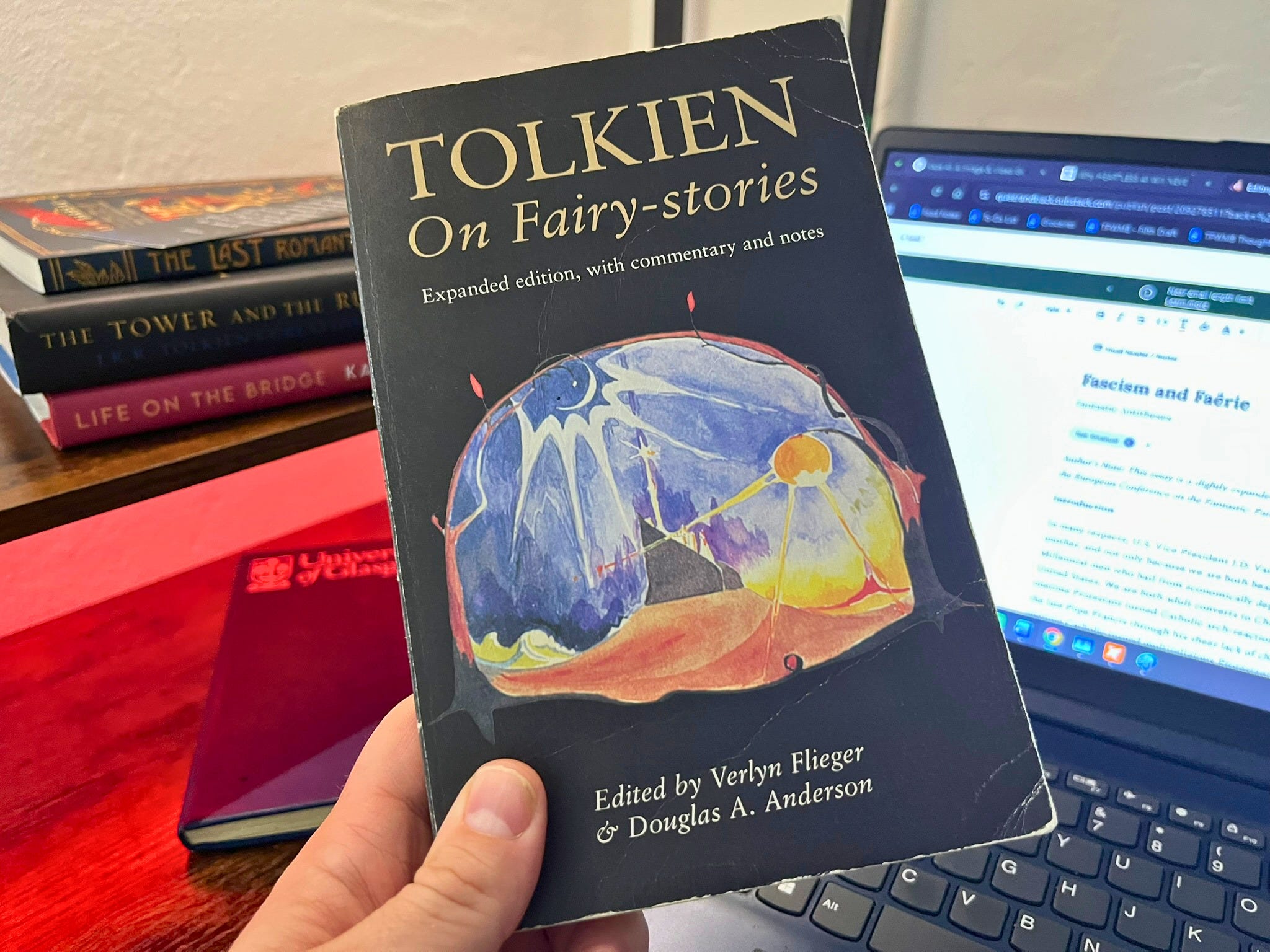
Tolkien, J.R.R. 2008. Tolkien On Fairy-stories. Edited by Verlyn Flieger and Douglas A. Anderson. HarperCollins.
Tolkien, J.R.R. 2015. Smith of Wootton Major. Edited by Verlyn Flieger. HarperCollins.
Tolkien, J.R.R. 2015. Smith of Wootton Major. Edited by Verlyn Flieger. HarperCollins.
Tolkien, J.R.R. 2023. The Letters of J.R.R. Tolkien: Revised and Expanded Edition. Edited by Humphrey Carpenter with the assistance of Christopher Tolkien. HarperCollins.
Wren, Adam. 2024. “How Lord of the Rings Shaped J.D. Vance’s Politics.” Politico, July 19. URL.
Young, Helen. 2026. “Fantasy and/or Reality: Imaging the Past-Present-Future.” Keynote address, European Conference on the Fantastic: Fantasy’s Present Pasts, University of Glasgow, June 23.
I'm working on an entry for the following contest.
https://berggruen.org/essay-competition-open
This essay is relevant. Thank you.
An excellent and fair-minded essay. Tolkien’s attitude toward power and control is absolutely key to understanding him.